 Add to Chrome
 Add to Firefox
 Add to Edge
Can MLLMs Reason Beyond Language? VisReason: A Comprehensive Benchmark for Vision-Centric Reasoning
May 25, 2026
Recent multimodal large language models (MLLMs) achieve strong performance on visual reasoning benchmarks, yet it remains unclear to what extent such performance reflects reasoning directly grounded in visual evidence. We introduce VisReason, a benchmark for vision-centric reasoning in everyday scenarios where perception and inference are tightly coupled. VisReason contains 1,505 questions across 10 categories spanning perceptual, structural, and conceptual reasoning. Our evaluation shows that VisReason poses a qualitatively different challenge from existing benchmarks, exposing substantial gaps between humans and current MLLMs and revealing limited benefits from test-time reasoning strategies. VisReason offers a focused diagnostic for evaluating vision-centric reasoning beyond language.

Semantic-Enriched Latent Visual Reasoning
May 19, 2026Multimodal latent-space reasoning aims to replace explicit thinking with images by performing visual reasoning directly in a compact latent space. However, existing approaches largely rely on visual supervision and produce latent representations that lack sufficient semantic richness, limiting their ability to support diverse region-level reasoning tasks. In this work, we introduce Semantic-Enriched Latent Visual Reasoning (SLVR), a two-stage learning framework that enriches latent representations with attribute-level visual semantics and aligns them with diverse reasoning objectives. In the first stage, SLVR learns semantically enriched region-centric latents under fine-grained attribute supervision. In the second stage, we design Multi-query Group Relative Policy Optimization (M-GRPO) to align latent representations across multiple queries grounded in the same region. To support this framework, we construct SLV-Set, comprising approximately 400K region-level attribute annotations and 800K multi-query question answering samples, and introduce SV-QA, a benchmark that evaluates latent reasoning under semantic variation. Experiments demonstrate that SLVR improves the robustness and semantic consistency of latent visual reasoning compared to existing baselines.
When Robots Do the Chores: A Benchmark and Agent for Long-Horizon Household Task Execution
May 14, 2026Long-horizon household tasks demand robust high-level planning and sustained reasoning capabilities, which are largely overlooked by existing embodied AI benchmarks that emphasize short-horizon navigation or manipulation and rely on fixed task categories. We introduce LongAct, a benchmark designed to evaluate planning-level autonomy in long-horizon household tasks specified through free-form instructions. By abstracting away embodiment-specific low-level control, LongAct isolates high-level cognitive capabilities such as instruction understanding, dependency management, memory maintenance, and adaptive planning. We further propose HoloMind, a VLM-driven agent with a DAG-based long-horizon hierarchical planner, a Multimodal Spatial Memory for persistent world modeling, an Episodic Memory for experience reuse, and a global Critic for reflective supervision. Experiments with GPT-5 and Qwen3-VL models show that HoloMind substantially improves long-horizon performance while reducing reliance on model scale. Even top models achieve only 59% goal completion and 16% full-task success, underscoring the difficulty of LongAct and the need for stronger long-horizon planning in embodied agents.
SciVQR: A Multidisciplinary Multimodal Benchmark for Advanced Scientific Reasoning Evaluation
May 11, 2026Scientific reasoning is a key aspect of human intelligence, requiring the integration of multimodal inputs, domain expertise, and multi-step inference across various subjects. Existing benchmarks for multimodal large language models (MLLMs) often fail to capture the complexity and traceability of reasoning processes necessary for rigorous evaluation. To fill this gap, we introduce SciVQR, a multimodal benchmark covering 54 subfields in mathematics, physics, chemistry, geography, astronomy, and biology. SciVQR includes domain-specific visuals, such as equations, charts, and diagrams, and challenges models to combine visual comprehension with reasoning. The tasks range from basic factual recall to complex, multi-step inferences, with 46% including expert-authored solutions. SciVQR not only evaluates final answers but also examines the reasoning process, providing insights into how models reach their conclusions. Our evaluation of leading MLLMs, including both proprietary and open-source models, reveals significant limitations in handling complex multimodal reasoning tasks, underscoring the need for improved multi-step reasoning and better integration of interdisciplinary knowledge in advancing MLLMs toward true scientific intelligence. The dataset and evaluation code are publicly available at https://github.com/CASIA-IVA-Lab/SciVQR.
M$^3$-VQA: A Benchmark for Multimodal, Multi-Entity, Multi-Hop Visual Question Answering
Apr 28, 2026We present M$^3$-VQA, a novel knowledge-based Visual Question Answering (VQA) benchmark, to enhance the evaluation of multimodal large language models (MLLMs) in fine-grained multimodal entity understanding and complex multi-hop reasoning. Unlike existing VQA datasets that focus on coarse-grained categories and simple reasoning over single entities, M$^3$-VQA introduces diverse multi-entity questions involving multiple distinct entities from both visual and textual sources. It requires models to perform both sequential and parallel multi-hop reasoning across multiple documents, supported by traceable, detailed evidence and a curated multimodal knowledge base. We evaluate 16 leading MLLMs under three settings: without external knowledge, with gold evidence, and with retrieval-augmented input. The poor results reveal significant challenges for MLLMs in knowledge acquisition and reasoning. Models perform poorly without external information but improve markedly when provided with precise evidence. Furthermore, reasoning-aware agentic retrieval surpasses heuristic methods, highlighting the importance of structured reasoning for complex multimodal understanding. M$^3$-VQA presents a more challenging evaluation for advancing the multimodal reasoning capabilities of MLLMs. Our code and dataset are available at https://github.com/CASIA-IVA-Lab/M3VQA.
AdaSpark: Adaptive Sparsity for Efficient Long-Video Understanding
Apr 09, 2026Processing long-form videos with Video Large Language Models (Video-LLMs) is computationally prohibitive. Current efficiency methods often compromise fine-grained perception through irreversible information disposal or inhibit long-range temporal modeling via rigid, predefined sparse patterns. This paper introduces AdaSpark, an adaptive sparsity framework designed to address these limitations. AdaSpark first partitions video inputs into 3D spatio-temporal cubes. It then employs two co-designed, context-aware components: (1) Adaptive Cube-Selective Attention (AdaS-Attn), which adaptively selects a subset of relevant video cubes to attend for each query token, and (2) Adaptive Token-Selective FFN (AdaS-FFN), which selectively processes only the most salient tokens within each cube. An entropy-based (Top-p) selection mechanism adaptively allocates computational resources based on input complexity. Experiments demonstrate that AdaSpark significantly reduces computational load by up to 57% FLOPs while maintaining comparable performance to dense models and preserving fine-grained, long-range dependencies, as validated on challenging hour-scale video benchmarks.
Thinking in Streaming Video
Mar 13, 2026Real-time understanding of continuous video streams is essential for interactive assistants and multimodal agents operating in dynamic environments. However, most existing video reasoning approaches follow a batch paradigm that defers reasoning until the full video context is observed, resulting in high latency and growing computational cost that are incompatible with streaming scenarios. In this paper, we introduce ThinkStream, a framework for streaming video reasoning based on a Watch--Think--Speak paradigm that enables models to incrementally update their understanding as new video observations arrive. At each step, the model performs a short reasoning update and decides whether sufficient evidence has accumulated to produce a response. To support long-horizon streaming, we propose Reasoning-Compressed Streaming Memory (RCSM), which treats intermediate reasoning traces as compact semantic memory that replaces outdated visual tokens while preserving essential context. We further train the model using a Streaming Reinforcement Learning with Verifiable Rewards scheme that aligns incremental reasoning and response timing with the requirements of streaming interaction. Experiments on multiple streaming video benchmarks show that ThinkStream significantly outperforms existing online video models while maintaining low latency and memory usage. Code, models and data will be released at https://github.com/johncaged/ThinkStream
S1-MMAlign: A Large-Scale, Multi-Disciplinary Dataset for Scientific Figure-Text Understanding
Jan 01, 2026Multimodal learning has revolutionized general domain tasks, yet its application in scientific discovery is hindered by the profound semantic gap between complex scientific imagery and sparse textual descriptions. We present S1-MMAlign, a large-scale, multi-disciplinary multimodal dataset comprising over 15.5 million high-quality image-text pairs derived from 2.5 million open-access scientific papers. Spanning disciplines from physics and biology to engineering, the dataset captures diverse visual modalities including experimental setups, heatmaps, and microscopic imagery. To address the pervasive issue of weak alignment in raw scientific captions, we introduce an AI-ready semantic enhancement pipeline that utilizes the Qwen-VL multimodal large model series to recaption images by synthesizing context from paper abstracts and citation contexts. Technical validation demonstrates that this enhancement significantly improves data quality: SciBERT-based pseudo-perplexity metrics show reduced semantic ambiguity, while CLIP scores indicate an 18.21% improvement in image-text alignment. S1-MMAlign provides a foundational resource for advancing scientific reasoning and cross-modal understanding in the era of AI for Science. The dataset is publicly available at https://huggingface.co/datasets/ScienceOne-AI/S1-MMAlign.
UrbanNav: Learning Language-Guided Urban Navigation from Web-Scale Human Trajectories
Dec 10, 2025
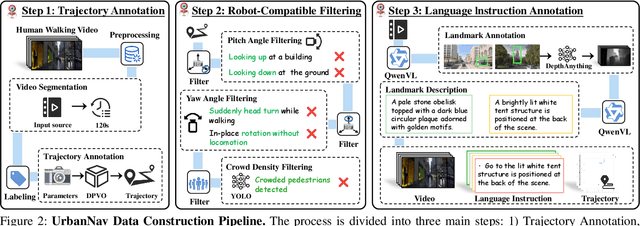
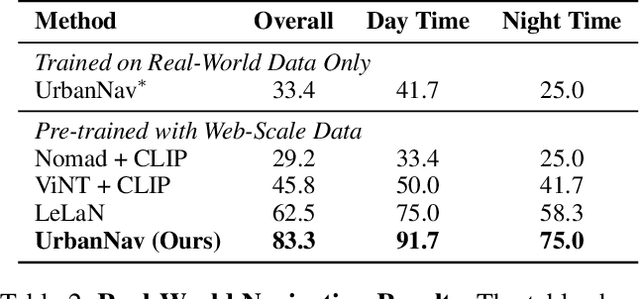
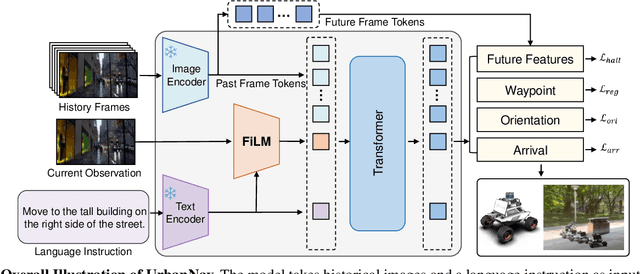
Navigating complex urban environments using natural language instructions poses significant challenges for embodied agents, including noisy language instructions, ambiguous spatial references, diverse landmarks, and dynamic street scenes. Current visual navigation methods are typically limited to simulated or off-street environments, and often rely on precise goal formats, such as specific coordinates or images. This limits their effectiveness for autonomous agents like last-mile delivery robots navigating unfamiliar cities. To address these limitations, we introduce UrbanNav, a scalable framework that trains embodied agents to follow free-form language instructions in diverse urban settings. Leveraging web-scale city walking videos, we develop an scalable annotation pipeline that aligns human navigation trajectories with language instructions grounded in real-world landmarks. UrbanNav encompasses over 1,500 hours of navigation data and 3 million instruction-trajectory-landmark triplets, capturing a wide range of urban scenarios. Our model learns robust navigation policies to tackle complex urban scenarios, demonstrating superior spatial reasoning, robustness to noisy instructions, and generalization to unseen urban settings. Experimental results show that UrbanNav significantly outperforms existing methods, highlighting the potential of large-scale web video data to enable language-guided, real-world urban navigation for embodied agents.
Prefix Grouper: Efficient GRPO Training through Shared-Prefix Forward
Jun 05, 2025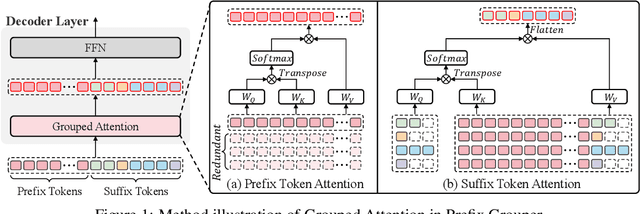
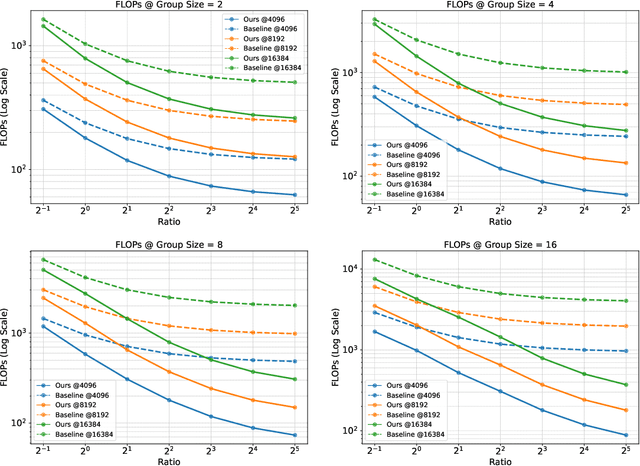
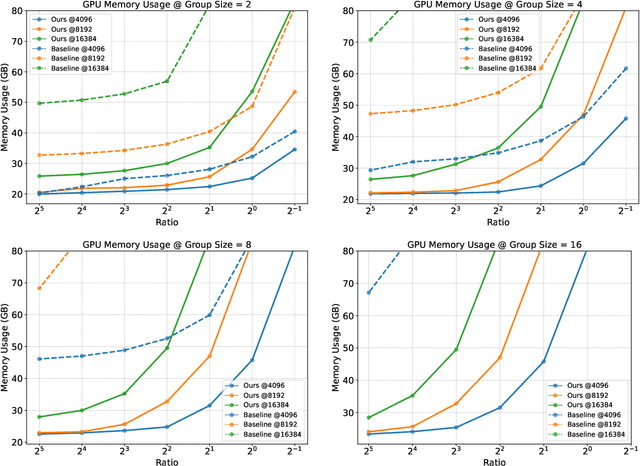
Group Relative Policy Optimization (GRPO) enhances policy learning by computing gradients from relative comparisons among candidate outputs that share a common input prefix. Despite its effectiveness, GRPO introduces substantial computational overhead when processing long shared prefixes, which must be redundantly encoded for each group member. This inefficiency becomes a major scalability bottleneck in long-context learning scenarios. We propose Prefix Grouper, an efficient GRPO training algorithm that eliminates redundant prefix computation via a Shared-Prefix Forward strategy. In particular, by restructuring self-attention into two parts, our method enables the shared prefix to be encoded only once, while preserving full differentiability and compatibility with end-to-end training. We provide both theoretical and empirical evidence that Prefix Grouper is training-equivalent to standard GRPO: it yields identical forward outputs and backward gradients, ensuring that the optimization dynamics and final policy performance remain unchanged. Empirically, our experiments confirm that Prefix Grouper achieves consistent results while significantly reducing the computational cost of training, particularly in long-prefix scenarios. The proposed method is fully plug-and-play: it is compatible with existing GRPO-based architectures and can be seamlessly integrated into current training pipelines as a drop-in replacement, requiring no structural modifications and only minimal changes to input construction and attention computation. Prefix Grouper enables the use of larger group sizes under the same computational budget, thereby improving the scalability of GRPO to more complex tasks and larger models. Code is now available at https://github.com/johncaged/PrefixGrouper